
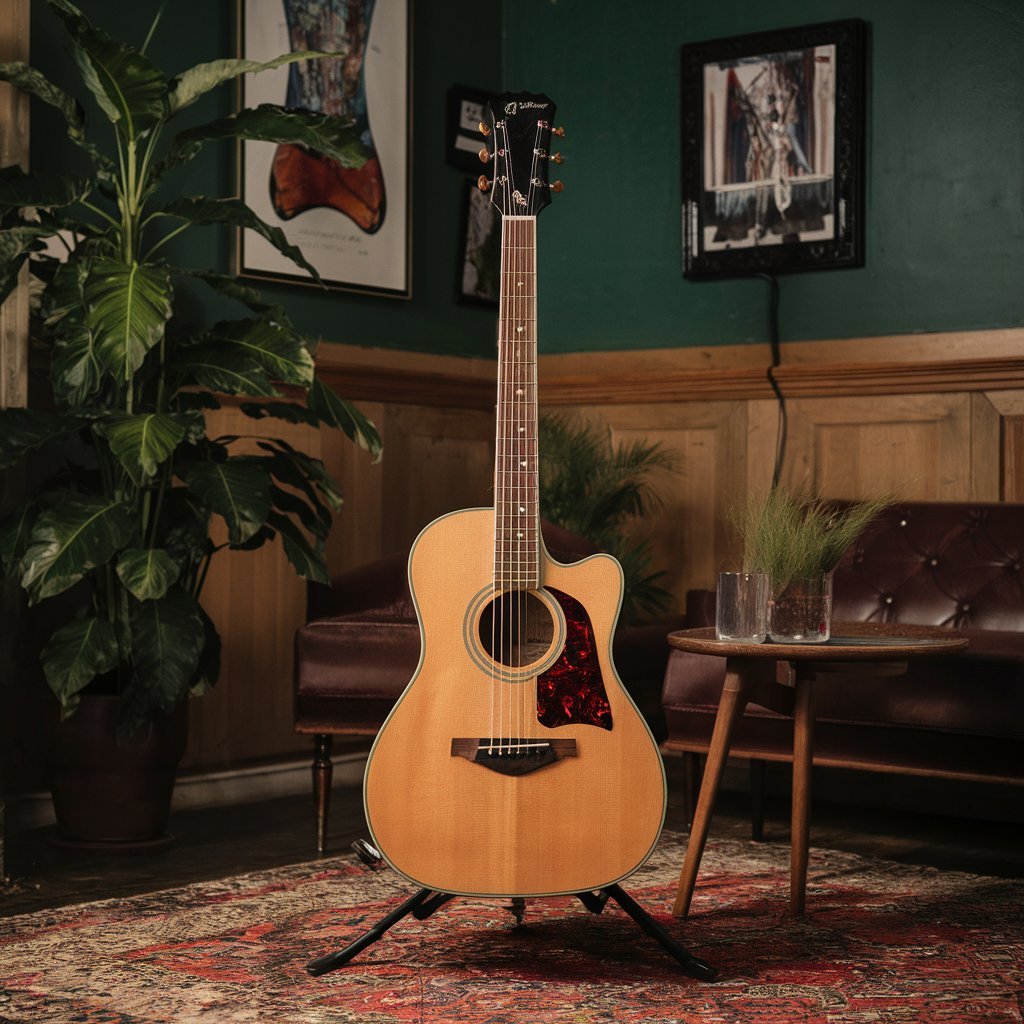
In the world of musical instruments, innovation often arises at the intersection of tradition and experimentation. The Hitaar, a unique hybrid guitar, is one such innovation: a fusion of acoustic richness and electric versatility. It promises the warmth and resonance of an acoustic body alongside the amplified power and tonal control of an electric guitar. Emerging in recent years as a compelling option for players who want “the best of both worlds,” the Hitaar offers new sonic possibilities for musicians, educators, and studios alike. In this article, we will explore the origins and evolution of the Hitaar, examine how it’s constructed, discuss its playing techniques, compare it with conventional guitars, explore who is using it today, and anticipate how it might develop further in the musical landscape.
The Origins and Evolution of the Hitaar
To truly appreciate the Hitaar, one must trace the journey of stringed instruments through history. The ancestral roots of modern guitars lie in ancient lutes, ouds, and early plucked instruments whose designs evolved over centuries. As technology advanced, musicians and luthiers experimented with electrification, seeking to amplify sound without losing tonal character. The hybrid guitar concept—that of combining acoustic resonance and electric amplification—was a natural progression of this quest.
The Hitaar, in its current form, appears to be an embodiment of that hybrid concept. According to one description, the Hitaar “combines the acoustic and electric features of traditional guitars.” hyperjerk.com This suggests that designers built it to overcome the limitations of pure acoustic (which struggle with amplification) and pure electric (which may lack body resonance) by integrating both systems in a single instrument.
Over time, designers refined internal bracing, body materials, electronics, pickup configurations, and feedback suppression mechanisms to optimize the hybrid form. Today’s Hitaar designs often incorporate advanced transducers, internal sound chambers, and smart electronics—bridging centuries of guitar development into one instrument.
How Hitaar Is Designed & Built
The engineering behind the Hitaar is at once complex and elegant. Its architecture must balance acoustic body resonance and clean electric signal capture, while minimizing interference or unwanted feedback. Key design elements include:
-
Body & Bracing: The body often resembles an acoustic guitar’s shape, with internal bracing optimized to support resonance without overpowering electronic pickups. Some designs may include chambered bodies (hollow or semi-hollow) to retain acoustic character.
-
Pickups / Transducers: A Hitaar typically uses a combination of piezoelectric, magnetic, or under-saddle transducers to capture string vibration. Some models may blend these signals to allow switching or mixing between acoustic and electric tones.
-
Electronics & Preamp: Because the acoustic component needs a preamp to boost the weak transducer signal, the Hitaar includes on-board electronics—volume and tone controls, blending knobs, and sometimes modeling circuitry or built-in effects.
-
Feedback Control: One challenge for hybrid instruments is feedback when amplified at high volumes. Designers often implement feedback reduction methods like sound hole dampers, notch filters, or internal baffles to mitigate resonance peaks.
-
Bridge, Saddle & Bridge Plate: The bridge and saddle interface must transmit string vibration to both the body (for acoustic resonance) and the transducer elements. Bridge plates may be reinforced to manage dual signals.
This careful integration of mechanical design and electronics allows the Hitaar to shift seamlessly between—or mix—acoustic and electric voices, offering a flexible palette for performance and recording.
How to Play the Hitaar: Techniques & Tips
Playing a Hitaar demands both conventional guitar technique and awareness of its hybrid nature. Here are some considerations and tips:
-
Blending Modes
Use the blending control (if present) to mix acoustic and electric signals. For clean rhythm, you might lean more acoustic; for solos or effects, you might favor electric tone. -
Control Feedback
At higher amplification levels, avoid too much acoustic resonance that causes feedback. Use notch filters or cut certain frequencies. Some players dampen the sound hole or use partial muting techniques with the picking hand. -
Tuning & Setup
Use standard guitar tuning as baseline. But because of the hybrid build, regular setup (action, intonation) is critical: the string height, saddle height, and pickup alignment all matter more. -
Effects & Signal Chain
You can run the electric output through pedals, amps, or modeling units. If your Hitaar lets you isolate acoustic output, you might process it separately (for instance, adding reverb or compression to the acoustic side). -
Dynamic Playing
Use dynamics (soft vs hard picking) to exploit the responsiveness of the acoustic component, while the electric side captures sustain and coloration. -
Practice Feedback Awareness
Start at low volume, gradually raise where needed, and monitor for stray noise or resonance. Adjust your blend and EQ settings accordingly.
As with any instrument, practice is essential—but hybrid instruments reward players who understand both sides of their voice.
Hitaar vs Traditional Acoustic & Electric Guitars
When considering investing time or money into a Hitaar, one should compare its advantages and trade-offs relative to conventional guitars:
-
Pros of the Hitaar
-
Versatility: One instrument can achieve both acoustic warmth and electric clarity.
-
Space & Cost Efficiency: Instead of owning separate guitars, you may use one hybrid instrument.
-
Expressive Potential: Blending or switching voices mid-song enables creativity.
-
Recording Simplicity: You can capture multiple tones without mic setup on acoustic bodies.
-
-
Challenges / Cons
-
Complexity & Cost: The additional electronics and hybrid structure make construction more demanding and expensive.
-
Maintenance: More components (preamp, pickups, wiring) introduce more points of failure or tuning adjustments.
-
Compromise of Ideal Performance: It may not quite match the absolute purity of a dedicated top-line acoustic or electric guitar in specialized roles.
-
Feedback Risk: Especially at high stage volumes, feedback is a perennial concern.
-
In sum, the Hitaar is not necessarily a replacement for acoustic or electric guitars—it’s a creative tool for artists who want flexible tonal range and hybrid expression.
Who’s Using Hitaar Today? Artists, Genres & Use Cases
Because the Hitaar is still relatively novel, it’s gaining traction among adventurous musicians, boutique instrument makers, and experimental genres. Key use cases include:
-
Singer-songwriters who want to shift between soft acoustic tones and overdriven electric textures during live performance without changing instruments.
-
Studio musicians & producers who appreciate capturing both acoustic and electric signals simultaneously for mixing versatility.
-
Fusion & experimental genres where blending styles (folk, rock, ambient) is common.
-
Instrument builders & luthiers looking to push boundaries by merging traditional craftsmanship with modern electronics.
As more artists adopt the Hitaar in performance and recordings, we can expect to see more innovations in wiring, switching, and hybrid instrument design.
The Future of the Hitaar: Trends & Possibilities
Looking ahead, several trajectories seem likely for the Hitaar:
-
Smarter Electronics: Onboard signal processing, modeling, and dynamic tone blending could make Hitaar instruments more flexible.
-
Modular Designs: Systems where pickups or electronics can be swapped or upgraded might become more common.
-
Lighter / Compact Bodies: Advances in materials could allow slimmer hollow or semi-hollow bodies without sacrificing resonance.
-
Feedback Suppression Technology: Better algorithms or mechanical designs might reduce feedback more effectively, enabling cleaner amplification.
-
Broader Market Acceptance: As awareness spreads, more manufacturers may produce midrange Hytaars, making them more accessible to players beyond niche markets.
In that way, the Hitaar has the potential to shift from a novelty to a mainstream option for musicians seeking versatility.
Conclusion
The Hitaar stands at an intriguing crossroads—where acoustic tradition meets electric innovation. It embodies the desire of many musicians to transcend limitations and merge tonal worlds. While it carries challenges—cost, maintenance, feedback—it offers a powerful creative tool for those willing to explore its unique voice. As instrument designers, players, and recording professionals continue to experiment, the Hitaar may well become a recognized staple in the arsenal of modern musical expression. Whether you’re a guitarist curious about hybrid instruments or a songwriter seeking new textures, the Hitaar invites you to rethink what a guitar can do.
FAQ (Frequently Asked Questions)
Q1: What exactly is a Hitaar?
A Hitaar is a hybrid guitar that blends acoustic body resonance with electric pickup and amplification capability in one instrument. Its design seeks to provide the warmth of acoustic tone and the flexibility of electric sound in a unified form.
Q2: How is a Hitaar different from an acoustic-electric guitar?
An acoustic-electric guitar is essentially an acoustic guitar with a pickup installed. The Hitaar, by contrast, is engineered from the ground up to integrate both acoustic and electric systems, often with specialized bracing, dual transducers, blending electronics, and feedback control—rather than being a mere retrofit.
Q3: Is the Hitaar suitable for live performance?
Yes—with caveats. Its hybrid nature allows performers to shift between acoustic and electric voices mid-performance. However, careful attention to feedback control, signal blending, and stage setup is required, especially at high volume levels.
Q4: Does playing a Hitaar require a special technique?
Not necessarily a completely different technique, but players should be mindful of how dynamics, blending, and effects interact. Because the instrument responds to both acoustic and electric inputs, blending strategies and EQ control matter.
Q5: Can I get a Hitaar from major guitar brands?
At present, the Hitaar is more of a boutique or custom instrument concept. Some small luthiers and hybrid instrument makers may offer versions, but it’s not yet widely produced by mainstream guitar brands.
Q6: Will the Hitaar replace acoustic and electric guitars?
It’s unlikely to fully replace them. Rather, the Hitaar is best viewed as a complementary tool—one that offers flexibility but may sacrifice some specialization. For pure acoustic or electric use-cases, dedicated guitars may still excel.
